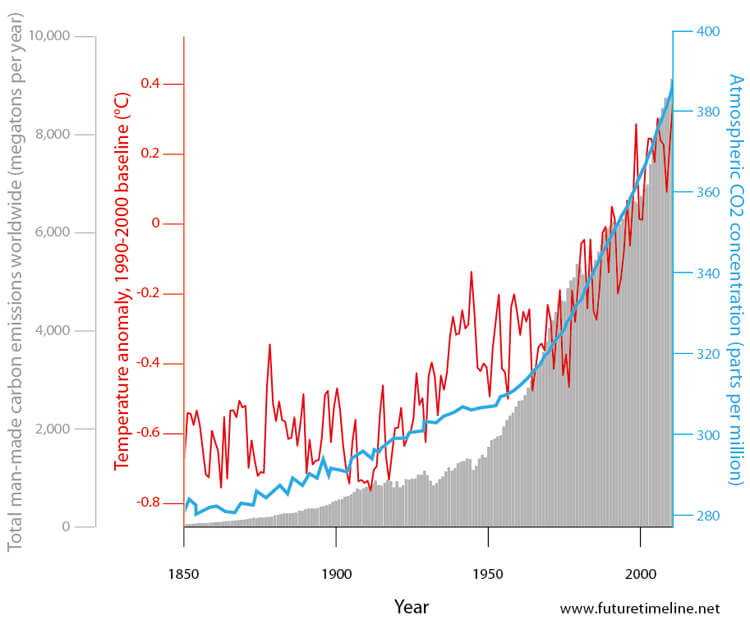
The earth today is not used in a sustainable way. The problems with global warming, and climate change comes largely from man-made carbon dioxide emissions, which has been proven but is unfortunately still debated. I believe that the facts from science beats people’s opinions every time, and the chart below proves my point about CO2 and its effect on temperature.
This post however, is not focused on the problem, but the solution to this problem. The solution to reducing CO2 emissions all over the world in the best way possible, exploiting behaviors of human competitiveness and greed to change the world from the current state, to a sustainable one.
By tracking down the major sources of CO2 emissions, the emissions originates from:
- Forestry
- Agriculture
- Industry
- Waste and waste water
- Energy supply
- Transport
- Residential and commercial buildings
 Out of all these sources, forestry, energy supply, industry, and agriculture are directly related to businesses - which adds up to 76% of all CO2 sources. Since the main purpose of a business is to make a profit, businesses are actually competing to contribute to the global warming - and eating up resources in a non-sustainable way.
It is estimated that the ecological resources of the planet sums up to around $50 trillion dollar for human purposes like filtering water and storing CO2 emissions, in other words - we have to pay our reduction in resources in one way or another. The solution to the problem of CO2 emissions is to look at why business does this in the first place - which is to make a profit, and change the way a business makes a profit. A profit is in it’s most basic form the result of what is left after subtracting expenses to the income. In order to make sure that businesses work in a sustainable way, we have to add ecological resources to the expenses category, to make businesses compete to make the earth sustainable again. What got us, humans, here in the first place was competitiveness and greed. Adding ecological resources in the financial statement would not only mean that expenses would be added, but companies can theoretically make money on i.e. planting trees to store CO2 - making ecological resources an income and not expenses. Assumed that the government sees this as an opportunity to save money by having a long term mindset.
Imagining a world where businesses and people make a profit from making the earth sustainable would finally leverage the human potential of being a force for good, rather than the destructive force we are today. The new mindset of working FOR the earth instead of against it would definitely turn the world around, and at the same time make sure that we can put food on our tables for ourselves and our kids. I really hope that it happens soon, otherwise we will experience a future that is not suitable for the generations to come.